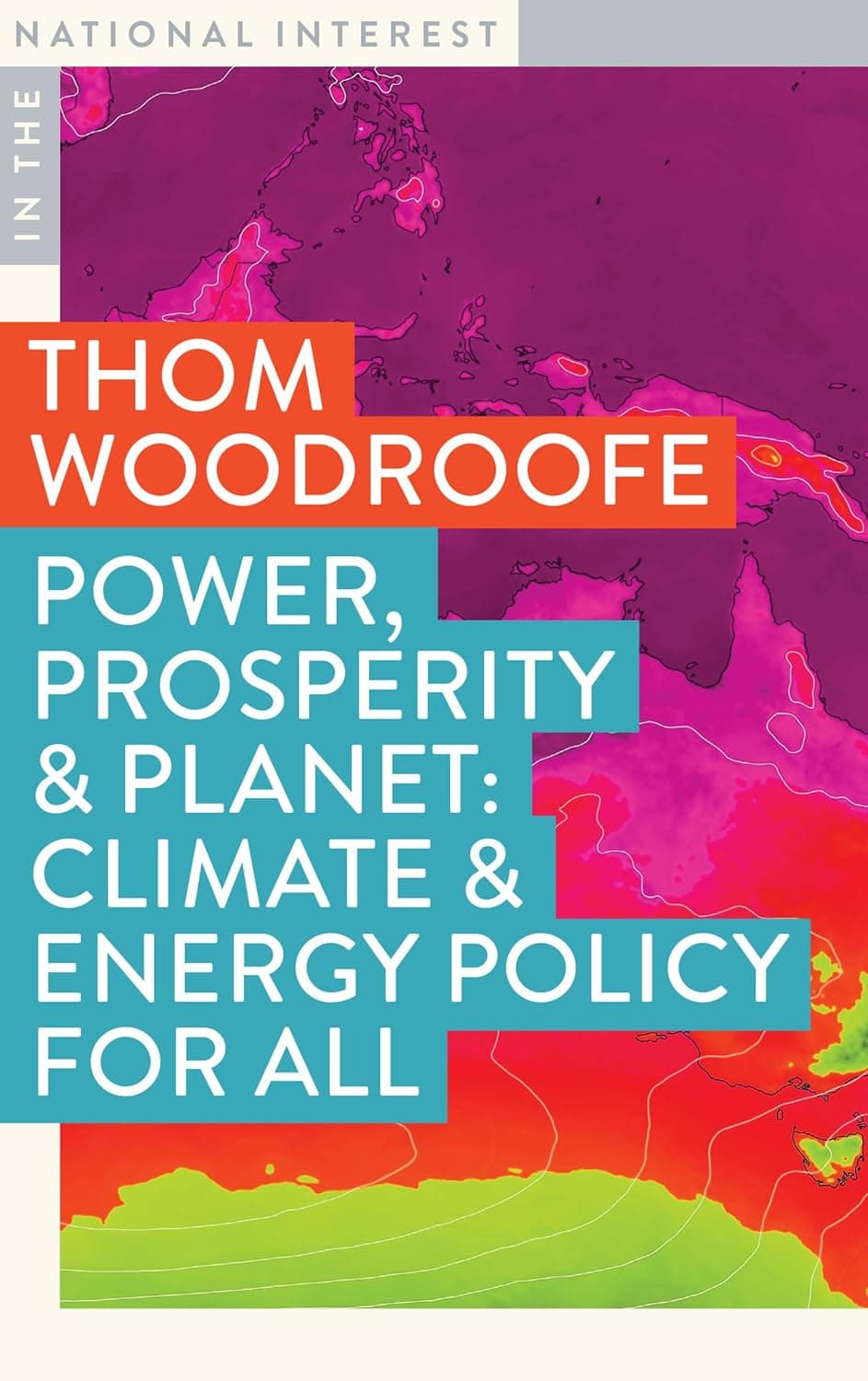
Power, Prosperity & Planet
by Thom Woodroofe
Mezy Fadhila
May 1, 2026
Non-Fiction
"After nearly two decades of “the climate wars”, arguments for climate action focus on power (we must decarbonise our energy system), prosperity (we must develop our green industries and clean tech) and planet (we must do more to keep global temperature increases within safe limits). But rarely are these arguments framed in terms of the impact on ordinary Australians. How will the transition to renewables keep electricity prices low for households? Given our continued reliance on fossil fuel exports, can Australia avoid falling off an economic cliff in the coming decades that would compromise quality of life? What will it cost our nation if large swathes of the country are at risk of climate-related disaster?
In this clear-sighted volume, Woodroofe argues that Australia needs to elevate climate change to our top foreign and economic policy priority. And we need to speak about it in a way that makes sense from the Cabinet Room to every lounge room across the mortgage belts and beyond. Because the ingredients that made us the lucky country – reliable power, economic prosperity and the beauty of our part of the planet, are at risk." Readings
What I Loved
Love the structure, just straight to the point: "how we get there, power, prosperity, planet, and what do we do next?"
Loved the opening when Thom dedicated his book to his daughters and put it like: For Elea, born in 417 ppm of CO2, and Ilmi, born at 430 ppm Co2. Loveee this touch. It shows you the concentration of CO2 at the moment they were born and keep increasing till today.
I love his insight; I just knew he was an Australian diplomat for the US.
The insights I love particularly are:
1. The fact that you can't deploy climate-related policy when people are still struggling with groceries, or essentially how to put food on the table or pay the monthly bill, and other basic necessities. I have read research on it that asks: can we still maintain our current lifestyle when we shift to a more sustainable way of living? And the answer is no. Very fascinating.
2. He is concerned with how to engage middle-income people to act for a more sustainable future. I think it makes sense because they are the majority in most societies around the world. If you can move them, you have basically done the heavy lifting for the largest portion of society.
3. He acknowledges that Australia is still the largest exporter of fossil fuel products. Australians are lucky to sit on huge reserves of this natural commodity. And moving forward, they still have reserves of massive critical minerals for chips and batteries. So, he argues that Australia needs to develop its supply chain to gain prosperity from its natural resources. Something I can relate to, and that sadly reminds me of Indonesia, my poor-circumstance country, where it is right now. 4. The insight is also about Norway, which can manage natural commodities very well in the past with sovereign investment. The newborn in Norway now instantly has hundreds of US dollars in their own bank account as an inheritance from the country. Accumulated to $2 million USD so far. Yuk bisa yuk Danantara. 5. The journey of Asutralia has been taking to shift to more renewable. They export efficient solar tech, but unfortunately it is largely adopted abroad rather than domestically. Thom feels sad about it. Relatable as well. But Thom also acknowledges that Australia is getting there, to 100% renewables. He acknowledges that Australia's biggest asset is its highly educated and trained workforce and scientists (which I agree with, OMG, that's why I am here now, studying).
Comments
Loading comments...