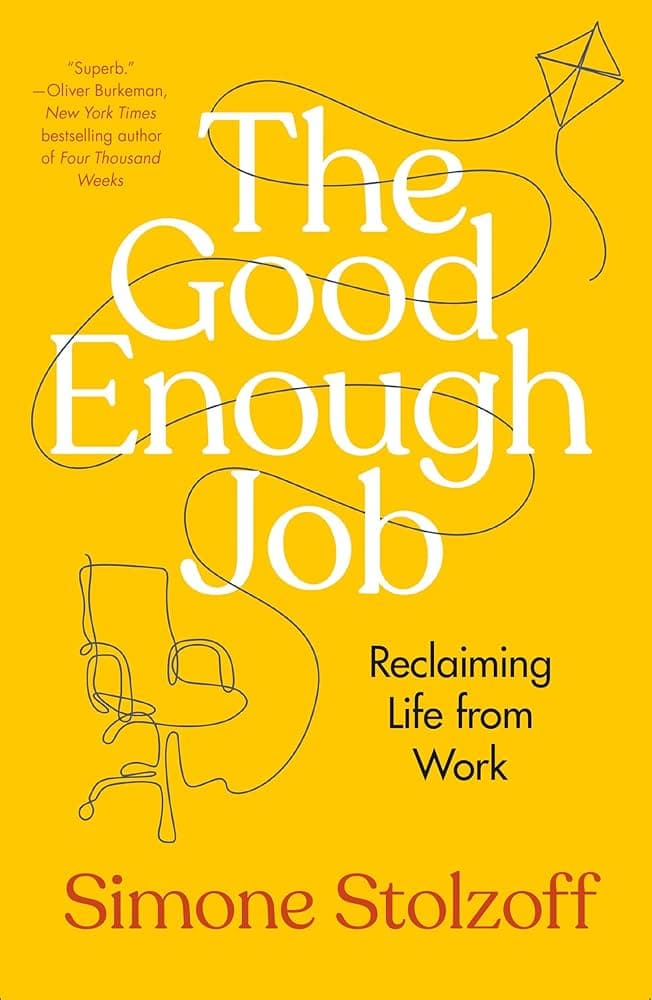
The Good Enough Job
by Simone Stolzoff
Mezy Fadhila
May 22, 2023
Non-Fiction
Claim: I listened to the Audiobook of the Summary of The Good Enough Job by Milky Media.
Currently, Workingism is like a religion, and the dream job is like a new god.
Work becomes primarily an institution for defining our personality and happiness, rather than for seeing a person as having a complex personality.
Family at the workplace is good, but dangerous. And the business-first attitude always comes first. The boundary between friend and colleague is challenging to define. Additionally, it includes a power-structure layer.
Working long hours vs quality work. Leisure time is essential for creative work. Four days in nature without access to technology can enhance creativity and problem-solving skills. In Japan, younger workers prefer not to receive promotions to avoid stress, whereas in New York, people tend to work longer hours.
There are two types of people in a workplace:
- 1. The integraters, the ones who can blur the work and personal life.
- 2. The segmenters who separate the line between the two.
Communicating with our employers can help clear the water.
Research shows that happiness does not equal game status, which everyone is now seeming to run into, climbing the ladder that they don't want to ascend. External reward can not fulfill your value-driven goals. You must align your values with the job that you want to do.
Changing the overwork culture will require substantial systemic change within our lifetime.
Work today seems like only exchanging labor for a paycheck. We need reorientation of expectations. Is working long hours the honest answer?
Now I am done with reading it in person (hardcopy one). I think it is big difference when you listened or read someone's review with your own personal experience.
I want to what I like, in below sections:
What I Loved
The research in it is good, with a variety of case studies from different places and contexts that make strong points.
It kinda brings me to an insight from the book Thinking, Fast and Slow by Daniel Kahneman: we should think twice about where our happiness lies and what we really want to chase in life.
Hardcopy post read:
It gave many case studies on how people perceive their relationship with work. From the one who presents themselves as a fresh graduate, works with the best mentor, builds a brand, gains profits from the brand, and, at the end, the mentor stabbed her in the back, the profits now become the lawyer's fee. And she found herself again, and learn to build her life from scratch, which was more fulfilling to her.
Comments
Loading comments...