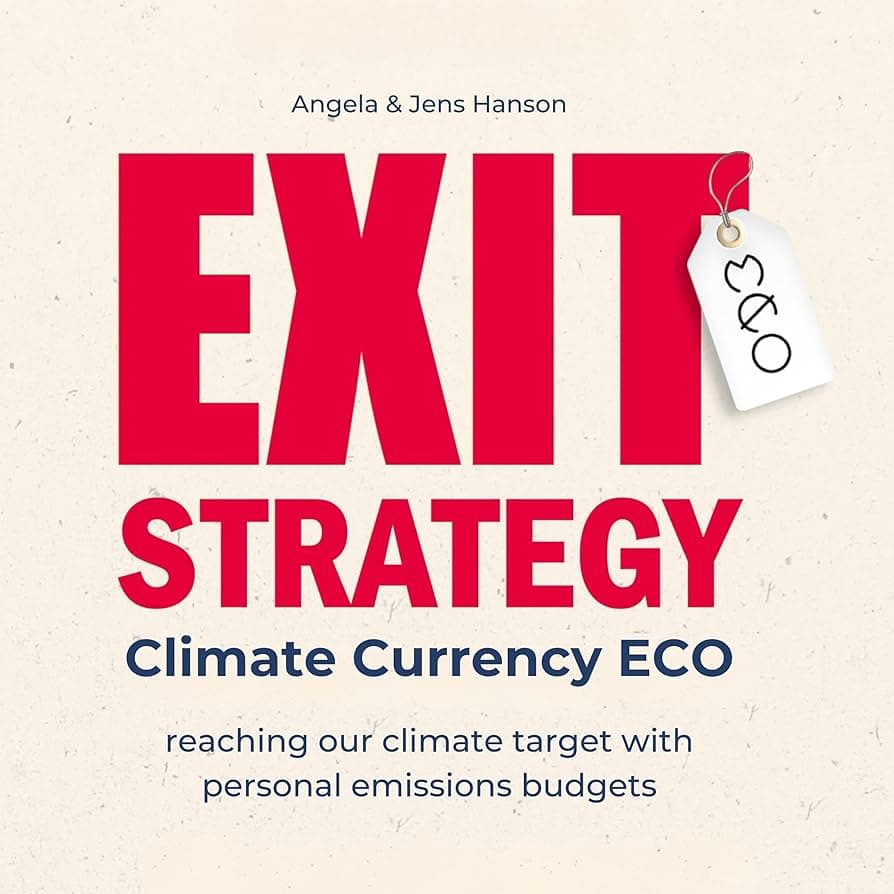
Exit-Strategy Climate Currency Eco: Reaching Our Climate Target with Personal Emissions Budgets
by Jens and Angela Hanson
Mezy Fadhila
August 19, 2024
Non-Fiction
The audiobook is about three hours long, and I mostly listened to it while doing the dishes over the span of three days.
Coincidentally, it was around the same time Patagonia released its latest sustainability report — which inspired me to start drafting a proposal for HC BP. I want to pitch myself as a passionate storyteller who can help rebrand Pertamina in a way that’s more aligned with today’s sustainability challenges and our path toward Net Zero 2060.
(“Are you a marketer now?” my husband joked — but honestly, why not give it a shot? It sounds interesting.)
I’m really glad I came across this book. I think the Hansons have put forward a solid piece of work — offering a clear, thoughtful proposal in the midst of all the noise surrounding carbon currencies today.
My notes:
1. The book explains climate change for a general audience, so I feel lucky to have some basic climate science — plus the decision-making and modelling knowledge from uni — to help me relate to the concepts in it.
2. Things that stood out:
• Daily climate-friendly habits are good, but they barely move the needle compared to industry-level impacts.
• The ECO currency was developed in Germany and proposed for use across the EU.
• ECO stays as ECO credits, not converted into Euros — so people can actually see how their activities affect the climate.
• Polluters still pay more, and that includes consumers who buy carbon-heavy products as the end users.
The ECO is a proposed climate currency that puts a separate, transparent “emissions price tag” on every product and service, reflecting its full greenhouse gas footprint along the entire supply/value chain.
Each individual receives a personal, tradable emissions budget monthly (a “carbon quota”), effectively a form of free ecological basic income — making emissions rights equally and fairly distributed across all citizens
When you buy goods or services, you “pay” part of your emissions budget (in ECO-currency or CO₂ units) — meaning your consumption directly uses up part of your personal carbon allowance
Mechanisms in EU context:
Transparent carbon pricing for all goods/services
Makes the “true ecological cost” of consumption visible to consumers, so choices can reflect climate impact rather than only price or convenience.
Personal emissions budgets (equal per capita)
Guarantees fairness and equity: everyone has the same allowance, so wealth doesn’t translate into more pollution rights.
Tradability of emissions allowances
Comments
Loading comments...